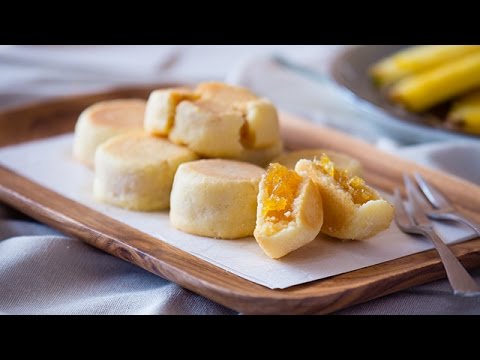
Authentic Taiwanese Pineapple Cakes (Feng Li Su)
Authentic Taiwanese Pineapple Cakes (Feng Li Su) is a intermediate Taiwanese recipe that serves 20. 110 calories per serving.
Prep: 1 hr 20 min | Cook: 25 min | Total: 2 hrs 10 min
Cost: $6.91 total, $0.35 per serving
Ingredients
- 1 large (about 1.2-1.5 lbs/550-700g flesh) Fresh pineapple (Taiwanese pineapple preferred, but any ripe pineapple works)
- 120 g Caster sugar (For filling (about 1/2 cup plus 1 tbsp))
- 35 g Maltose syrup (About 1 heaping tablespoon)
- 180 g Cake flour (About 1 1/2 cups, for crust)
- 100 g Unsalted butter (Softened to room temperature (about 7 tbsp))
- 40 g Caster sugar (For crust (about 3 tbsp))
- 1 large Egg (Beaten)
- 15 g Milk powder (About 1 1/2 tbsp, optional but recommended)
- 1 pinch Salt
- as needed All-purpose flour (For dusting hands and work surface)
Instructions
Prepare Pineapple
Cut off the leafy top of the pineapple. Slice off the skin along the sides. Use a paring knife to carve out the brown 'eyes' in v-shaped grooves. Quarter the pineapple lengthwise and remove the woody core from each quarter.
Time: PT10M
Chop Pineapple Flesh and Core
Slice the pineapple flesh into thin pieces, then strips, then finely chop. Slice and finely dice the core separately (as thin as possible due to its fibrous texture). Optionally, use a food processor to pulse the flesh and core separately.
Time: PT8M
Cook Pineapple Filling
Combine chopped pineapple flesh and core in a nonstick saucepan. Add 120g caster sugar. Cook over high heat, stirring, until sugar dissolves and juices release. Increase heat to reduce the mixture, stirring frequently, until fruit becomes translucent and sticky and most liquid has evaporated.
Time: PT18M
Temperature: High heat
Add Maltose and Finish Filling
Warm maltose syrup in the microwave for a few seconds to soften. Add to the pineapple mixture. Lower heat to low and cook, stirring constantly, until the filling thickens, turns pale when lifted, and then develops a light caramel color. Remove from heat.
Time: PT10M
Temperature: Low heat
Cool Pineapple Filling
Spread the cooked pineapple filling onto a plate to cool completely to room temperature.
Time: PT15M
Make Pineapple Black Tea (Optional)
Pour hot water into the pan with leftover pineapple bits. Bring to a boil, add a black tea bag, steep, strain, and chill for a refreshing drink.
Time: PT5M
Temperature: Boiling
Prepare Crust Dry Ingredients
Combine 15g milk powder and 180g cake flour in a bowl. Add a pinch of salt. Sift together.
Time: PT3M
Cream Butter and Sugar
In a stand mixer, beat 100g softened butter on medium-high until pale. Add 40g caster sugar and beat 2-3 minutes until very pale and doubled in size. Scrape bowl as needed.
Time: PT5M
Add Egg
Add 1 beaten egg to the butter mixture. Beat until fully incorporated and smooth.
Time: PT2M
Combine Wet and Dry Ingredients
Reduce mixer speed to low. Gradually add flour mixture to butter mixture. Mix until just combined—do not overmix. Finish folding with a spatula until no dry flour remains.
Time: PT3M
Chill Dough
Wrap dough in plastic wrap and refrigerate until slightly firm but still pliable (about 20 minutes).
Time: PT20M
Temperature: 4°C
Portion Filling
Divide cooled pineapple filling into 20 equal portions (about 15g each). Use two spoons or a scale for accuracy. Place portions on a plate and refrigerate for 30 minutes to firm up.
Time: PT10M
Temperature: 4°C
Roll Filling Balls
Roll each portion of filling into a ball. Lightly dust with flour and keep separate.
Time: PT5M
Portion and Shape Dough
Divide chilled dough in half. Roll each half into a log and cut each into 10 pieces (20 total). Roll each piece into a ball, then flatten into a disc.
Time: PT5M
Wrap Filling
Place a filling ball onto a dough disc. Gently gather and seal the dough around the filling, pinching to close. Roll gently to smooth and shape into a thick disc (like a chess piece). Repeat for all cakes.
Time: PT12M
Preheat Oven
Preheat oven to 170°C (338°F).
Time: PT5M
Temperature: 170°C
Shape and Arrange Cakes
Sprinkle flour on the counter. Gently press and roll each cake to achieve an even, round shape. Arrange on a parchment-lined baking sheet, spaced apart.
Time: PT5M
Bake Cakes (First Side)
Bake cakes in preheated oven for 10 minutes at 170°C (338°F).
Time: PT10M
Temperature: 170°C
Flip and Finish Baking
Carefully flip each cake using two spatulas. Bake for another 5-8 minutes at 170°C (338°F), until golden on both sides.
Time: PT8M
Temperature: 170°C
Cool and Store
Let cakes cool completely on a rack. Once cool, store in an airtight container. Best flavor and texture develop after resting overnight.
Time: PT10M
Cleanup
Wash all used utensils, bowls, pans, and work surfaces. Wipe down counters and store equipment.
Time: PT25M
Nutrition Facts
- Calories
- 110
- Protein
- 1g
- Carbohydrates
- 17g
- Fat
- 4g
- Fiber
- 0.7g
Dietary info: Vegetarian, low-carb, low-calorie, very-low-calorie, low-fat
Allergens: Eggs, Milk (butter, milk powder), Wheat (gluten)
Ingredient Substitutions
- Instead of Fresh pineapple: Canned pineapple (in juice, not syrup, well drained)
- Instead of Caster sugar: Granulated sugar (pulse to finer texture)
- Instead of Maltose syrup: Honey (texture will be softer), Corn syrup (less authentic)
- Instead of Cake flour: All-purpose flour (texture will be less tender)
- Instead of Unsalted butter: Salted butter (omit added salt), Vegan butter (for dairy-free)
- Instead of Caster sugar: Granulated sugar (pulse to finer texture)
- Instead of Egg: Egg replacer (for vegan, texture will differ)
- Instead of Milk powder: Same amount cake flour (if omitting)
Equipment Needed
- Chef's knife
- Paring knife
- Cutting board
- Food processor (optional)
- Nonstick saucepan or skillet
- Wooden spoon or heatproof spatula
- Microwave (optional)
- Mixing bowls
- Stand mixer or hand mixer (optional)
- Sifter (optional)
- Plastic wrap/cling film
- Kitchen scale (optional)
- Baking sheet/roasting pan
- Parchment paper (optional)
- Oven
- Spatula (for flipping)
Critical Steps — Do Not Skip
- Cook pineapple filling until thick and sticky before adding maltose.
- After adding maltose, cook on low and stir constantly to avoid burning.
- Cream butter and sugar thoroughly for a tender crust.
- Do not overmix dough after adding flour.
- Seal dough well around filling to prevent leaks.
- Be gentle when flipping hot cakes during baking.
Chef Tips from the Video
- Use only pineapple for the most authentic flavor; avoid winter melon for a richer, tangier filling.
- If your hands are warm and dough gets sticky, dust with flour or chill briefly.
- For a more professional look, use square or rectangular molds.
- Resting the cakes overnight improves flavor and texture.
- Leftover pineapple syrup in the pan makes a delicious tea—don't waste it!
Troubleshooting
Filling is too runny.
Cook longer to evaporate more liquid before adding maltose.
Filling leaks out during baking.
Ensure dough is sealed well around filling and not too thin.
Crust is tough.
Do not overmix after adding flour; use cake flour for tenderness.
Cakes spread too much in oven.
Chill dough and filling thoroughly before shaping and baking.
Cakes stick to baking sheet.
Use parchment paper or a nonstick mat.
Storage
Refrigerator: Up to 1 week in an airtight container.
Freezer: Up to 2 months, well-wrapped. Thaw at room temperature.
Room temperature: 3-4 days in a cool, dry place in an airtight container.
Make-Ahead Tips
- Pineapple filling can be made up to 3 days ahead and refrigerated.
- Dough can be made 1 day ahead and chilled. Let soften slightly before using.
- Assembled, unbaked cakes can be frozen and baked from frozen (add 2-3 minutes to baking time).
Frequently Asked Questions
What is the cultural significance and history of Authentic Taiwanese Pineapple Cakes (Feng Li Su) in Taiwanese cuisine?
Authentic Taiwanese Pineapple Cakes (Feng Li Su) originated in the 19th‑century tea trade era, where pineapples were a symbol of wealth and good fortune. They became popular as gifts during Lunar New Year and wedding celebrations, representing prosperity. Over time, they have become an iconic Taiwanese pastry enjoyed by locals and tourists alike.
What are the traditional regional variations of Authentic Taiwanese Pineapple Cakes (Feng Li Su) within Taiwanese cuisine?
In southern Taiwan, especially Tainan, the crust is often richer with added lard for a flaky texture, while northern versions use more butter for a crumbly bite. Some coastal regions incorporate a hint of ginger or lime zest in the pineapple jam. However, the classic version from central Taiwan sticks to pure pineapple filling without winter melon.
What is the authentic traditional way Authentic Taiwanese Pineapple Cakes (Feng Li Su) are served in Taiwanese culture?
Traditionally, Authentic Taiwanese Pineapple Cakes (Feng Li Su) are presented on a bamboo platter with a tea cup, allowing the buttery crust to complement the bitterness of oolong tea. They are often sliced into bite‑size squares and served at room temperature, sometimes dusted with a light sprinkle of powdered sugar for extra elegance.
During which occasions or celebrations is Authentic Taiwanese Pineapple Cakes (Feng Li Su) traditionally associated in Taiwanese culture?
Authentic Taiwanese Pineapple Cakes (Feng Li Su) are a staple gift during Lunar New Year, weddings, and business openings because the pineapple (鳳梨) sounds like “prosperity arrives” in Mandarin. They are also offered to guests during Mid‑Autumn Festival gatherings and as souvenirs for tourists visiting Taiwan.
How does Authentic Taiwanese Pineapple Cakes (Feng Li Su) fit into the broader Taiwanese cuisine tradition?
These pineapple cakes embody the Taiwanese love for balanced sweet‑sour flavors and buttery pastries, echoing the island’s blend of Chinese, Japanese, and indigenous culinary influences. They sit alongside other iconic snacks like sun cakes and mochi, highlighting Taiwan’s reputation for refined, handheld desserts.
What are the authentic traditional ingredients for Authentic Taiwanese Pineapple Cakes (Feng Li Su) versus acceptable substitutes?
The authentic recipe uses fresh pineapple, caster sugar, maltose syrup, cake flour, and unsalted butter. Acceptable substitutes include using golden syrup instead of maltose for a similar viscosity, or substituting a portion of cake flour with all‑purpose flour if cake flour is unavailable, though texture may be slightly less tender.
What other Taiwanese dishes pair well with Authentic Taiwanese Pineapple Cakes (Feng Li Su) for a balanced snack platter?
Pair Authentic Taiwanese Pineapple Cakes (Feng Li Su) with lightly salted soy‑milk pudding (豆花) or a small serving of taro ball soup (芋圓) to balance the sweet, buttery flavor. A cup of high‑mountain oolong tea or a glass of cold milk tea also complements the pastry beautifully.
What makes Authentic Taiwanese Pineapple Cakes (Feng Li Su) special or unique in Taiwanese cuisine?
Their uniqueness lies in the pure pineapple jam that delivers a bright, tangy taste without winter melon, setting them apart from mass‑produced versions. The buttery, crumbly crust, achieved by creaming butter with cake flour, creates a melt‑in‑the‑mouth texture that is celebrated across Taiwan.
How has Authentic Taiwanese Pineapple Cakes (Feng Li Su) evolved over time in Taiwanese culture?
Originally a home‑made treat, the cakes have evolved into a commercial gift item with modern packaging, yet many bakers still adhere to the hand‑crafted method. Recent trends include adding premium ingredients like gold leaf or using organic pineapples, but the core technique and flavor profile remain unchanged.
What are common misconceptions about Authentic Taiwanese Pineapple Cakes (Feng Li Su) among people unfamiliar with Taiwanese cuisine?
A frequent misconception is that all pineapple cakes contain winter melon or are overly sweet; the authentic version relies solely on fresh pineapple for a natural tartness. Another myth is that they must be baked until golden brown; in fact, a pale‑gold crust indicates the proper buttery crumb that defines the traditional texture.
What are the most common mistakes to avoid when making Authentic Taiwanese Pineapple Cakes (Feng Li Su) at home?
Avoid over‑cooking the pineapple jam, which can turn it into a thick, caramelized paste and lose its bright flavor. Also, do not over‑mix the dough; excessive gluten development will make the crust tough instead of crumbly. Finally, ensure the butter is softened but not melted before creaming.
Can I make Authentic Taiwanese Pineapple Cakes (Feng Li Su) ahead of time and how should I store them?
Yes, you can bake the cakes a day ahead. Store them in an airtight container at room temperature; they stay fresh for up to five days. For longer storage, wrap individual pieces in parchment paper and freeze; thaw at room temperature before serving.
What does the YouTube channel that posted the Authentic Taiwanese Pineapple Cakes (Feng Li Su) video specialize in?
The YouTube channel that posted the Authentic Taiwanese Pineapple Cakes (Feng Li Su) video specializes in traditional Taiwanese home cooking, focusing on classic pastries and festive dishes. It emphasizes authentic techniques, ingredient sourcing, and cultural storytelling behind each recipe.
Last updated: August 25, 2026


![Authentic Pasta Fagioli Recipe: How to make Italian Pasta e Fagioli [One-Pot]](https://img.youtube.com/vi/2Hgi6PrxoHI/hqdefault.jpg)