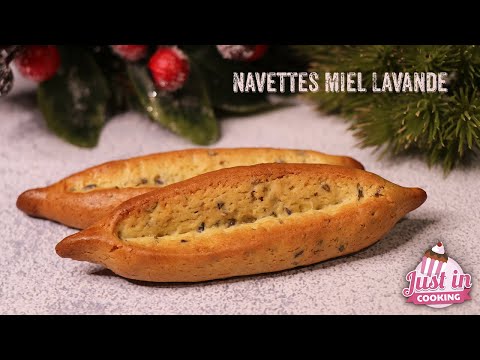
Navettes provençales à la lavande et au miel
Navettes provençales à la lavande et au miel is a medium Française recipe that serves 16. 80 calories per serving. Recipe by JustInCooking on YouTube.
Prep: 4 hrs 1 min | Cook: 11 min | Total: 4 hrs 27 min
Cost: $2.02 total, $0.13 per serving
Ingredients
- 180 g Farine tout usage (Tamiser avant utilisation)
- 5 g Levure chimique (baking powder)
- 2 g Sel fin
- 2 g Fleurs de lavande séchées comestibles (Parfumer la pâte, à ne pas confondre avec la lavande d'ornement)
- 1 unité Œuf (À température ambiante)
- 80 g Sucre en poudre
- 40 ml Huile d'olive extra vierge (À température ambiante)
- 20 g Miel de lavande (Peut être remplacé par du miel doux)
- 20 ml Lait entier (Pour badigeonner les navettes)
Instructions
Tamiser les ingrédients secs
Dans un grand saladier, tamiser la farine, la levure chimique et le sel à l'aide d'un tamis.
Time: PT5M
Incorporer la lavande
Ajouter les fleurs de lavande séchées aux ingrédients secs et mélanger uniformément.
Time: PT2M
Mousse d'œuf et sucre
Dans un autre saladier, casser l'œuf, ajouter le sucre et fouetter au batteur électrique pendant environ 8 minutes jusqu'à ce que le mélange devienne mousseux et pâle.
Time: PT8M
Ajouter huile et miel
Verser l'huile d'olive et le miel de lavande dans le mélange œuf‑sucre et fouetter doucement pour incorporer.
Time: PT2M
Former la pâte
Incorporer le mélange sec au mélange humide à l'aide d'une spatule, puis pétrir à la main jusqu'à obtenir une boule de pâte homogène légèrement collante.
Time: PT5M
Repos au frais
Envelopper la pâte dans du film alimentaire et la placer au réfrigérateur pendant 3 heures.
Time: PT3H
Diviser la pâte
Après repos, peser la pâte (environ 380 g) et la diviser en 16 portions de 24 g chacune à l'aide d'une balance de cuisine.
Time: PT10M
Façonner les navettes
Rouler chaque morceau en boudin d'environ 11 cm de long, puis pincer légèrement les extrémités pour former la forme caractéristique.
Time: PT10M
Préparer la plaque
Disposer les navettes sur une plaque à pâtisserie recouverte de papier cuisson, puis les fendre délicatement sur toute leur longueur avec un couteau bien aiguisé.
Time: PT5M
Badigeonner de lait
À l'aide d'un pinceau de cuisine, badigeonner légèrement chaque navette avec le lait entier.
Time: PT2M
Préchauffer le four
Préchauffer le four à 180 °C en mode chaleur tournante.
Time: PT10M
Temperature: 180°C
Cuisson
Enfourner les navettes et cuire 10‑12 minutes, jusqu'à ce qu'elles soient légèrement dorées.
Time: PT11M
Temperature: 180°C
Refroidissement
Sortir les biscuits, les placer sur une grille et laisser refroidir complètement avant de les conserver.
Time: PT20M
Nutrition Facts
- Calories
- 80
- Protein
- 1 g
- Carbohydrates
- 12 g
- Fat
- 3 g
- Fiber
- 0.5 g
Dietary info: vegetarian, contains gluten, contains honey, low-carb, low-calorie, very-low-calorie, low-fat
Allergens: gluten, eggs, milk, honey
Last updated: April 14, 2026